Carbon Footprint

Advanced Industries Packaging has been measuring, monitoring, and reducing its greenhouse gas emissions since 2017. Since then, emissions have steadily decreased through a combination of increased use of renewable electricity, investments in energy-efficient equipment, and continuous improvements in our supply chain, where the majority of our emissions occur (Scope 3).

Close collaboration with suppliers and more sustainable sourcing practices have played a key role in reducing our overall carbon footprint.

Towards a Greener Future

Reducing our carbon footprint is a key part of AIP’s sustainability strategy. We continuously monitor and reduce greenhouse gas emissions across our operations and value chain by increasing the use of renewable energy, improving energy efficiency, and working closely with suppliers to lower Scope 3 emissions.

Through these efforts, we contribute to climate action while building a more sustainable and resilient packaging industry.

Journey Towards Lowering Greenhouse Gas Emissions

AIP has been measuring, monitoring, and reducing its greenhouse gas emissions since 2017.

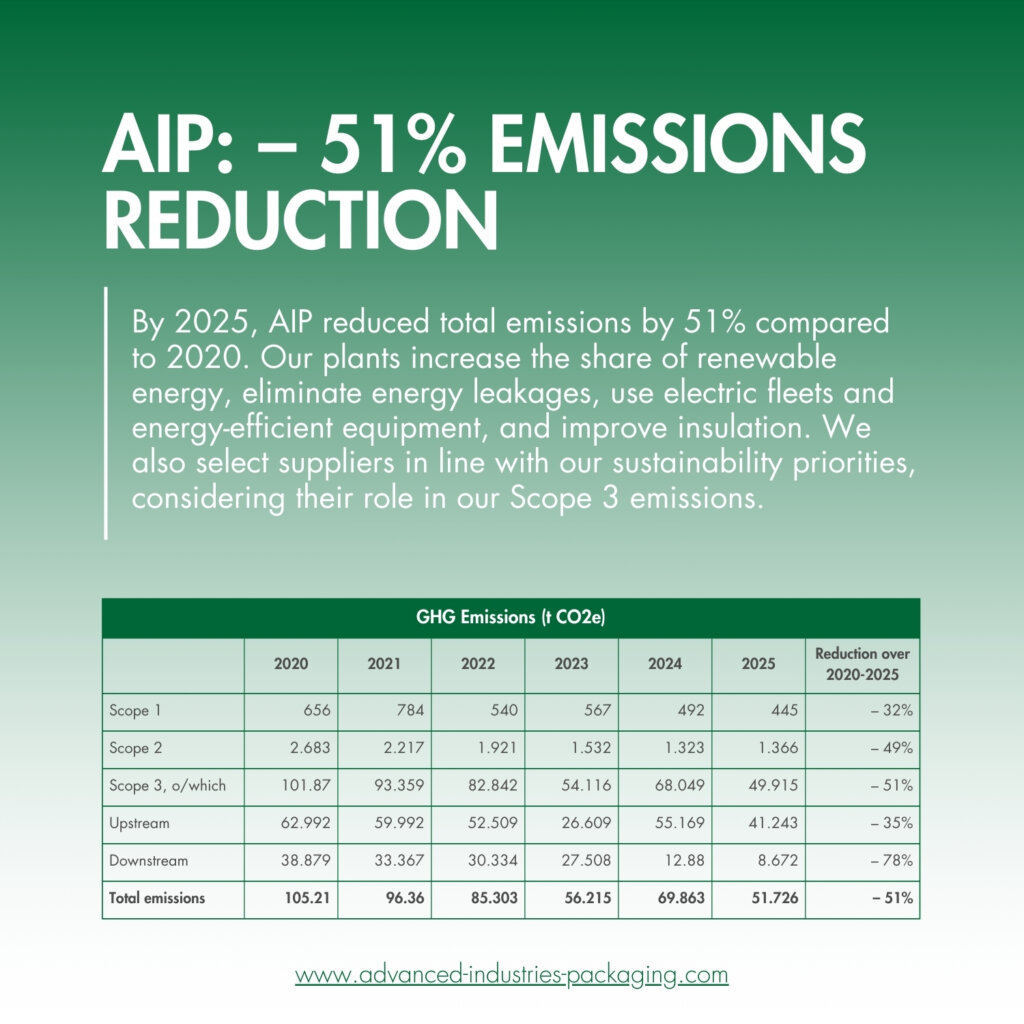
Between 2020 and 2025, total emissions were reduced by 51%, largely driven by improvements in our supply chain, where the majority of our emissions occur (Scope 3).

Through close collaboration with suppliers and more sustainable sourcing practices, we have significantly lowered our carbon footprint.

Additional reductions were achieved by increasing the share of renewable electricity across our sites and investing in energy-efficient operations and equipment.

Direct and Indirect Environmental Impact

Scope 1 includes direct emissions from sources owned or controlled by the company, such as fuel combustion in heating systems, company-owned vehicles, and the leakage of greenhouse gases.

Scope 2 covers indirect emissions generated from purchased energy, including electricity, district heating, cooling, and steam.

Scope 3 includes all other indirect emissions across the value chain, such as emissions from purchased raw materials, transportation, waste management, and the use and end-of-life treatment of products. For AIP, Scope 3 represents the largest share of total greenhouse gas emissions.

Implemented Measures to improve Carbon Footprint:
  • Awareness training for employees on energy efficiency and emissions reduction;
  • Purchase of renewable electricity at our plants in Denmark, the Netherlands, Romania, Italy, and Germany;
  • Use of energy-efficient technologies and equipment, including LED lighting, energy-efficient IT equipment, and electric/hybrid forklifts;
  • Implementation of energy efficiency programs across all sites;
  • Close collaboration with suppliers to reduce Scope 3 emissions through more sustainable sourcing practices and lower-carbon raw materials;
  • Continuous optimization of product design and material selection to reduce the overall carbon footprint of our paper sacks.